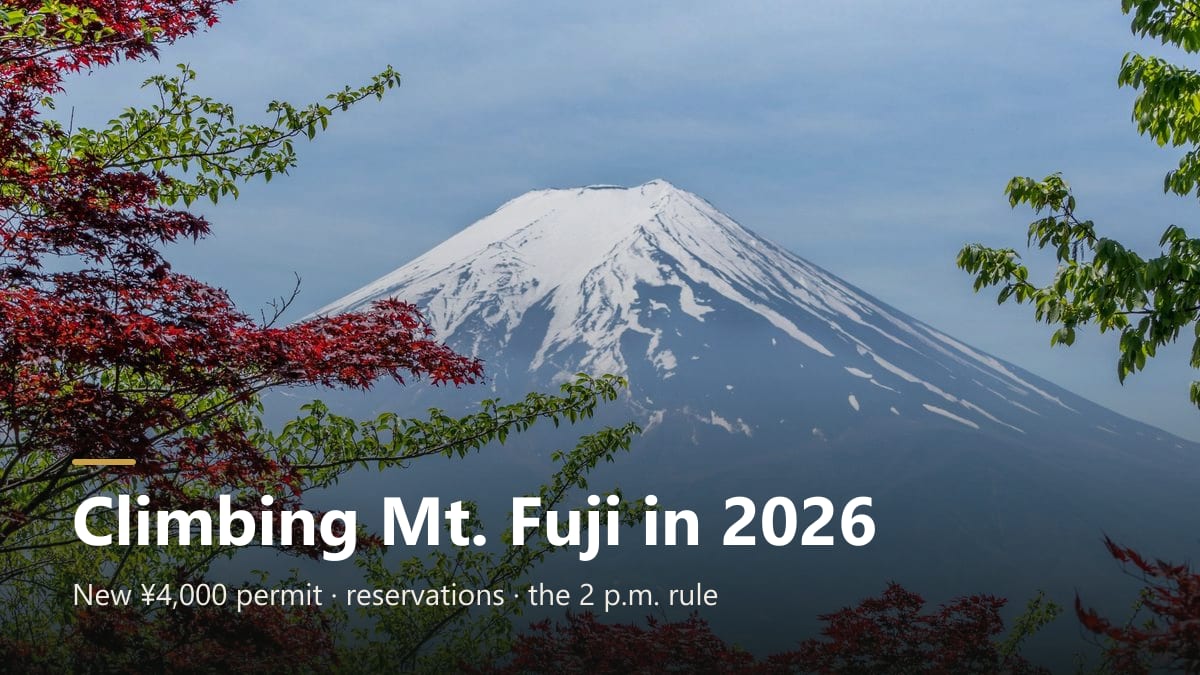
Climbing Mt. Fuji in 2026? You can't just turn up anymore — here's the new drill
By Trip Japan YLP Editorial TeamPublished by Trip Japan YLP
In this article
You've probably seen that photo a hundred times — the near-perfect cone, a ribbon of cloud caught halfway up — and thought, one day I'll climb that. Good news: this summer you can. The slightly less fun news: you can't just wander up to the trailhead the way people did a few years ago.
Japan has tightened the rules on its most famous mountain, and for 2026 there's a little homework to do before you set off. Don't let that put you off, though. It's all manageable, and honestly the changes make for a calmer, safer climb. Here's what you actually need to know.
When the mountain is open
Fuji's official season is short — about ten weeks, and that's it. For 2026, the Yoshida Trail (the popular one, on the Yamanashi side) and the Subashiri Trail open on the 1st of July. The Fujinomiya and Gotemba trails, plus the crater loop around the very top, open a little later, on the 10th of July. All four close on the 10th of September.
Those dates aren't a suggestion. Outside the season the huts shut, the buses stop, and a 3,776-metre volcano turns genuinely dangerous. Climb in the window.
The ¥4,000 you didn't used to pay
Here's the big one. Every one of the four trails now charges ¥4,000 per person, per climb. In return you get a permit — really a QR code you show at the fifth-station gate. No QR, no entry. It's the same price whichever route you pick, and it goes toward keeping the trails, the toilets and the safety patrols running on a mountain that sees a lot of feet each summer.
Reserving your spot
This is where the two sides of Fuji work a bit differently.
On the Yoshida Trail (Yamanashi), booking online ahead of time is optional — but smart. Pay your ¥4,000 in advance and you breeze through the gate with your QR code instead of queuing. There's also a hard cap of 4,000 climbers a day here; once the gate hits that number it closes, so a fine summer weekend really can fill up. Prefer to keep things loose? Same-day tickets are sold at the counter, first come first served.
The three Shizuoka trails — Fujinomiya, Subashiri and Gotemba — ask for a touch more. You register through an app called Shizuoka FUJI NAVI, watch a short e-learning clip on mountain rules and manners, pay the fee, and collect your QR entry pass. No smartphone? You can do the whole thing at the trailhead — just budget about 30 minutes for it.
The 2 p.m. rule, and why "bullet climbing" is out
One rule catches a lot of people out: on every trail, if you start between 2 p.m. and 3 a.m., you must already hold a confirmed mountain-hut booking. It's aimed squarely at what the Japanese call dangan tozan — "bullet climbing", racing from the bottom to the summit through the night with no sleep to catch the sunrise.
It sounds heroic. In practice it lands a lot of people with altitude sickness, hypothermia and worse. And the proper way is honestly nicer anyway: book a hut partway up, sleep a few hours, then climb the last stretch in the dark to watch the sun lift over the clouds. That sunrise — goraikō — is the whole reason most people come.
A quick run-through before you go
- Pick your trail, then sort the ¥4,000 permit for that side (Yoshida online or at the counter; Shizuoka via the FUJI NAVI app).
- Want the summit sunrise? Book a mountain hut early — they fill up, and after 2 p.m. you can't climb without one.
- Coming from the Nagoya and central-Japan side? The Fujinomiya trail is the closest to you and starts highest, at around 2,400 metres.
- Warm layers, cash, a headlamp and water. It can be near freezing up top even in August.
Fuji has been a sacred mountain for centuries — a UNESCO World Heritage site since 2013 — and standing above the clouds at first light, you feel exactly why. A bit of paperwork is a small price for that.
We're a central-Japan team, so we won't be roping up the mountain with you — but if you're pairing Fuji with a few days around Nagoya, Gifu and Mie, that part we'd love to help plan. Take a look at the small-group days we run, and climb safe out there.
Planning a trip around central Japan? See the small-group days we run from Nagoya.
Browse all toursDid you enjoy this story?