Autumn leaves in central Japan 2026: when they turn, Kōrankei from Nagoya, and where the crowds aren't
By Trip Japan YLP Editorial TeamPublished by Trip Japan YLP
In this article
Every September we go back to the same number.
Japan's weather agency has an observer in Nagoya whose job includes watching one particular maple tree and writing down the day it turns red. Not a forecast. A record. In 2023 that day was 17 November. In 2024 it was 5 December. In 2025, 25 November.
Same tree, same city, same person looking. Almost three weeks apart.
So if you're asking when the leaves change in Japan this year, and where to see autumn leaves near Nagoya, here's the honest version. Nobody can name the day yet, and the first 2026 forecast points to a normal-to-late season. That's workable. This guide was written at the end of September 2026, and it covers what the forecast says, which dates are actually confirmed, how to get from Nagoya to Kōrankei without sitting in a traffic jam, and a few quieter valleys in Mikawa (the hilly eastern half of Aichi) for anyone who'd rather not queue.
When do the leaves change in Japan? Central Japan in 2026
Let's separate what we know from what we're guessing, because they're different things.
The usual pattern first. Kōyō (autumn colour; you'll also hear momiji, which is the maple itself) travels downhill. It starts high and comes down, roughly a month from summit to city. Mt Gozaisho, on the Mie side of the Suzuka mountains, stands 1,212 metres tall, and the ropeway company's own colour reports have the summit turning from the second half of October in a normal year. The mid-slopes catch up around mid-November. The hot-spring town at the bottom is still turning in late November.
Everything else lines up by height. The Kiso valley and the Hida highlands around Takayama and Shirakawa-gō, a few hundred metres up, usually run from late October into the first week of November. The maple gorges in the Aichi hills, Kōrankei among them, peak in the middle-to-late part of November. The valley parks down on the Gifu plain, Yoro for one, are the last, holding on from mid-November into early December.
Now the 2026 outlook. The first foliage forecast from Nippon Kishō, a private weather company, came out on 2 September. Its nationwide summary says that in many places the best time to see colour will be either "about normal" or "late". For Nagoya's maples it gave 2 December, four days behind the normal date of around 28 November, though the company still files that under "about normal". That's a forecast made a month before the leaves start, and the next update is due in early October. Treat it as a lean, not a promise. Our own reading, and it's ours rather than the forecaster's: plan leaning late, aim for the second half of the usual window, and keep early December in your back pocket.
Festival and light-up dates work the other way. Kōrankei's and Hōraiji-san's are already announced, and you'll find them under each place below; where a date isn't out yet, we say so. The leaves are the guess. The calendar, where it exists, isn't.
In the week before you travel, look at the foliage pages on Weathernews and on tenki.jp (run by the Japan Weather Association), which list colour spot by spot and update through the season. And please don't take a date off a blog post, this one included. If you're still choosing a month, our guide to the best time to visit central Japan sets autumn against the rest of the year, and the seasons page has the short version.
Kōrankei from Nagoya: dates, the light-up, and how to get there
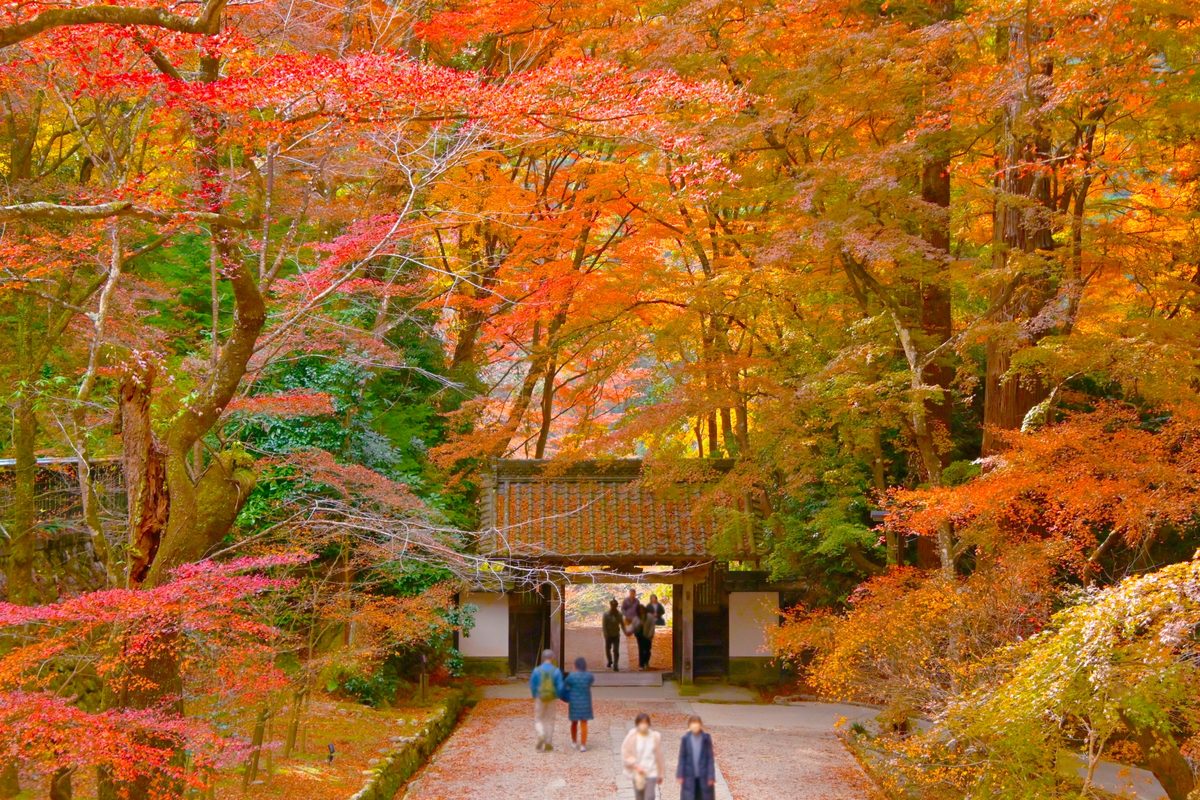
Kōrankei is the famous one, and it earns it. A wooded valley in Asuke, up in the hills of Toyota city, with somewhere between 3,000 and 4,000 maples of about eleven varieties (the count depends on who you ask) spilling down Mt Iimori to the Tomoe River. The planting is dated to around 1634 and credited to a priest of Kōjakuji temple, which means people have been coming for almost four centuries. The red arch of Taigetsukyō Bridge with scarlet leaves above it is the photograph you've probably already seen.
The 71st Kōrankei Momiji Festival runs from Sunday 1 November to Monday 30 November this year. The Mt Iimori light-up happens every evening of the festival, from sunset until 21:00, with no extension. There's the usual festival programme too (a monkey show, a ceremony, a parade), and the days for those are on the Asuke Tourism Association's page. Walking the valley is free. If you drive, the association lists parking at 1,000 yen a car.
Peak is normally mid-to-late November. If the leaves do lean late, the festival's last week is the one we'd aim for, or you may catch the valley half-turned. That's our reading, not a forecast.
By train and bus from Nagoya
There are two main routes. Neither is quick, but both beat a queue of cars.
Route one: Meitetsu from Nagoya station to Toyota-shi station (you change at Chiryū), then a Meitetsu bus toward Asuke, getting off at Kōrankei. The bus alone is about 50 minutes, so allow something like an hour and twenty minutes door to door. That total is our estimate, so pad it.
Route two: the Meitetsu Toyota line to its end at Jōsui station, then the Toyota Oiden bus bound for Hyakunensō, again getting off at Kōrankei. The bus takes about an hour.
If you're coming from the Okazaki side, there's a third option: a Meitetsu bus from Higashi-Okazaki station (the Okazaki–Asuke line) that takes about 70 minutes. One catch for evenings: according to the Asuke Tourism Association, there's no bus back to Higashi-Okazaki on weekdays after 19:00.
On payment, manaca works on the Meitetsu bus, and the Oiden bus takes manaca and the main transit IC cards, so you can tap in. Our IC card guide covers which card to get.
Two gaps we couldn't close. We couldn't confirm the bus fares, and we couldn't find a direct Nagoya to Kōrankei bus for the festival month. Check the operators' pages, or Google Maps, where the bus times show up in your language. Also check the last bus back on your own route before you commit to the light-up. We couldn't confirm evening timetables for the other routes, and the lights stay on until 21:00.
Landing at Chubu Centrair? The Meitetsu Mu-Sky into Nagoya takes about 28 minutes at the fastest. On top of the ordinary fare you pay 450 yen for the Mu ticket (the reserved seat); the base fare depends on the section and can change, so we haven't put a number on it for 2026. Add the trip above (about an hour and twenty minutes, our estimate) and it's around two hours from the airport to the valley, more once you count connections. So a light-up straight off a flight is a stretch. Give yourself a night in Nagoya first.
Beating the crowds
Kōrankei on a fine weekend in late November is properly busy. According to the association, Route 153 into Asuke has backed up for two hours or more on weekends, and weekdays are the recommended option. Two habits help. Go on a weekday if your plans can bend that way, and go early, because the valley in the first hour of light is a different place from the valley at two in the afternoon.
Our favourite trick is a weekday evening for the light-up itself. That's advice, not something we've measured, but a Tuesday night in the dark under lit maples is about as far from a Sunday afternoon as this valley gets. And leave the car behind. The buses above beat sitting on Route 153.
While you're in Asuke
Sanshū Asuke Yashiki, a living-history village where old rural crafts are demonstrated, makes a pleasant break. Admission is 300 yen for adults. It's open 9:00 to 17:00 (last entry 16:30) and normally closed on Thursdays, with the next day off if that Thursday is a public holiday. Hands-on workshops are charged separately. Temporary closures happen, so check before you go.
Four more places, each on its own clock
Obara, further into the same hills, is the strange one. The district has more than ten thousand shikizakura, four-season cherry trees that flower in autumn as well as spring. So you can stand there in mid-to-late November looking at pale pink blossom and burning red maple in the same frame. It shouldn't work. It absolutely does. The Shikizakura Festival usually runs from mid-November to the end of the month, and in recent years it has stretched into the first week of December (the venues include Obara Fureai Park). The 2026 dates weren't out when we checked, so ask the Obara tourism association.
Gozaisho is for people who want colour early. Its autumn season runs from mid-October to mid-November, so you can ride the ropeway up through the season and watch it change with altitude: green at the bottom, full colour when you step out at the top. It's the answer if your trip lands in October and you thought you'd missed autumn. One catch: in 2025 the town of Komono closed the Route 477 approach near the Kamoshika Bridge to private cars on weekends and holidays from 25 October to 24 November, 9:00 to 15:00. Drivers used a temporary car park at Kibōsō (1,000 yen a car) and a free shuttle bus. The 2026 dates weren't published when we checked, so look at the official notice before you drive.
Magome and Tsumago, two post towns on the old Nakasendō highway, let you walk through the leaves rather than stand in a crowd looking at them. The path between them is about 8 kilometres over Magome Pass, two and a half to three and a half hours on foot, and the colour usually runs from late October into mid-November. Dark timber walls, white plaster, red maple. It's a good day.
Yoro Falls and its park, out on the Gifu plain, is the late option and the gentle one. The park covers about 78 hectares, the walking paths run under arches of maple, and the colour typically lasts from mid-November into early December, which is handy if the season runs late. Whether there's a 2026 light-up hadn't been announced when we checked.
One more in case the season runs late: Jakkō-in, a temple in Inuyama known for its maples (about a thousand of them), usually peaks from late November into early December. It's walkable from Inuyama-Yūen station, and our Inuyama Castle page covers the town. Check the temple's 2026 festival dates before you plan around it.
Mikawa hidden gems: three quieter places
Mikawa is the eastern half of Aichi, and its hills are where the quiet is. None of these three is a name most visitors know, and that's the point.
Hōraiji-san, in Shinshiro, is known for its 1,425 stone steps. Its Maple Festival is listed for 9 November to 6 December this year, with the peak usually in mid-to-late November. Yuya Onsen is close by, so it pairs neatly with a hot-spring night. Our guide to central Japan's onsen towns has the details.
Ōi-daira Park, in Inabu (part of Toyota city), is a small place: about 520 maples, iroha-momiji and ginkgo, against Kōrankei's thousands. The colour usually peaks in early to mid-November, a little ahead of the bigger names. It's tied to the Inabu Maple Festival: in 2025 that ran 8 to 24 November, with the trees lit from sunset until 19:00 and a shuttle bus on weekends and holidays only, 10:00 to 16:00, during the festival. We couldn't confirm this year's dates, so check with the Inabu Tourism Association. We haven't confirmed a regular public transport route from Nagoya, so think of this one as a car or guided-day stop.
Chausuyama Kōgen, up in Toyone village at about 1,358 metres, is the early one. Colour usually arrives from late October into early November, which makes it a rescue plan for October travellers. There's a viewpoint on Hagitaro-yama and a ten-minute walking path around Yahazu Pond. In 2025 the light-up ran 17:00 to 20:00 on weekends and holidays only, so check this year's schedule. Public transport information is thin, so plan on a car.
Autumn leaves and tea: a day out in Kawane
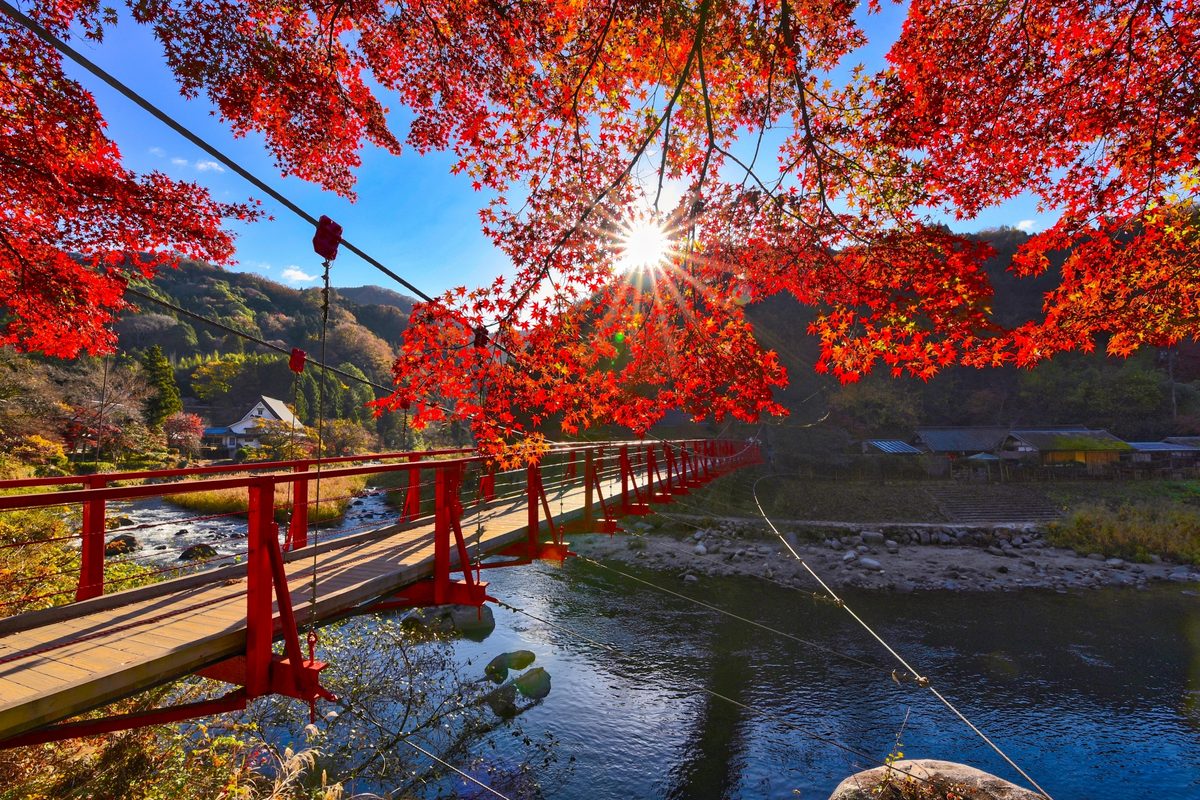
Some people like their autumn with a tea field in it, so here's one option that sits outside Aichi. Kawane, in Shizuoka, is tea country along the Ōi River. Further up the valley, Sumatakyō gorge has the Dream Suspension Bridge (Yume no Tsuribashi), and the colour there usually peaks in mid-to-late November.
It's not a hop from Nagoya, and it gets busy. At peak times the operator says the wait to cross can reach about 120 minutes, and the bridge runs one way when it's crowded. Autumn traffic arrangements for the bridge and the road up to it are announced closer to the time, so check the operator's news page before you go. Aim to arrive in the morning, and be off the bridge by 17:00.
The Ōigawa Railway's steam locomotives are the other famous draw. We couldn't confirm which sections or days will run in autumn 2026 (the line was damaged by a typhoon in 2022), so check the official timetable before building a day around it, and be ready for it not to be running.
If a slow day among the tea rows sounds like your kind of autumn, Kawane is one of the places we take guests ourselves: our Kawane tea day is a private day in the tea hills. It isn't the spring first-flush season (April to May), but autumn leaf can be picked, so the day works in autumn as a tea day rather than a foliage tour. If colour is what you're after, ask us what's realistic for the week you're coming. For how Kawane fits into Japan's tea map, see our tea regions guide.
What to wear in Japan in November, and a few practical bits
Nagoya in November averages about 17°C in the afternoon and 8°C before dawn, going by the meteorological agency's 1991 to 2020 normals (17.3 and 8.6, to be exact). October is 23.3 and 14.8. That sounds mild, and in the city it is.
The mountains are not the city. The summit of Gozaisho tends to run 8 to 10 degrees colder than the foot, going by travel reports rather than any official figure, and the wind up there will find every gap in your jacket. The gorges hold cold air too. Kōrankei in the shade at nine in the morning is a lot cooler than the Nagoya forecast suggests, and the evening light-up is colder again. Layers, a windproof outer, and something for your hands if you're staying for the lights.
A few small things that make the day easier. Stalls and little shops in places like Asuke are often cash-only, so bring some (our guide to cash in Japan explains how much). English signage around Asuke is limited, so have your route saved offline or on Google Maps. If you're moving between hotels, send the big bags ahead with luggage forwarding and take only a daypack up the valley.
Plan it like a local: use the altitude
Here's the trick that makes all of it work. Don't book one spot on one day and hope. Pick two places at different heights and keep both loose.
If the leaves run late this year, that might mean Kōrankei in the last week of November, with a higher spot like Chausuyama or a late one like Yoro as your second option. If you arrive early and the plains are still green, go up. If you arrive at the end of the month and the mountains are bare, come down.
Altitude is your spare day. Somewhere in this region, something is always turning. You just have to be willing to move a little.
Come in November if you can. Bring a jacket. Leave one day unspoken for.
Planning a trip around central Japan? See the small-group days we run from Nagoya.
Browse all toursDid you enjoy this story?